
How to separate pillar and supporting posts in a technical blog
Technical blogs start drifting when every post is treated as if it has the same job. Once that happens, internal links get messy, category lines blur, and expansion becomes harder than writing the next article.
The fix is simple in theory and often ignored in practice: separate the pillar post from the supporting post. One defines the frame. The others answer narrower questions inside it.
This post is about role separation, not publishing volume. The question is not how many posts you have. The question is whether each post has a clear structural job.
If the center of the topic is wrong, every later post makes the mistake bigger. That is why this is less a writing problem than a structural one.
1. The pillar post owns the frame
A pillar post should explain the broad problem space, define the key terms, and make the reader understand what sits inside the topic and what does not.
If a post cannot introduce the structure of the topic, it is probably not the pillar post. It may still be useful, but it should not carry the index role.
A good pillar post usually does three jobs at once:
- defines the boundary of the topic
- names the main sub-questions under it
- acts as the stable destination that narrower posts can link back to
2. The real mistake is not writing too little, but promoting the wrong post to the center
The most common structural failure is not lack of content. It is giving the center role to the wrong article.
This usually happens after a narrower post starts performing well. It is concrete, it ranks faster, and it feels more useful than the broader post. Then the blog quietly starts treating that narrow article as the center of the topic.
That feels efficient, but it creates a long-term problem. A narrow post can solve one question very well, yet still be a bad center because it cannot hold the rest of the topic around it. The moment you add more related posts, the structure starts tilting toward whatever happened to perform first.
That is why the pillar post should be chosen by structural value, not by short-term traction. The center post is the post that best explains the map. A supporting post may win more clicks, but the pillar post should still own orientation, scope, and role naming.
In practice, this is where many technical blogs drift without noticing. One post about internal links gets traction, so every later post starts linking to it. Then a category cleanup post is published, but it also links into that same internal-link post because it already looks central. A few months later, the blog has traffic, but no stable map.
The fix is usually not replacing the pillar. The fix is restoring roles. The narrow post keeps its traffic job. The pillar post keeps its map job. Once those roles are separated again, adding the next article becomes easier instead of more confusing.
That is the point where a blog starts feeling organized instead of accidental. Readers may not name the structure explicitly, but they feel the difference immediately when every later post lands in a place that already makes sense.
3. Supporting posts solve narrower questions
Supporting posts should not repeat the whole structure. Their job is to solve one narrower problem under the pillar.
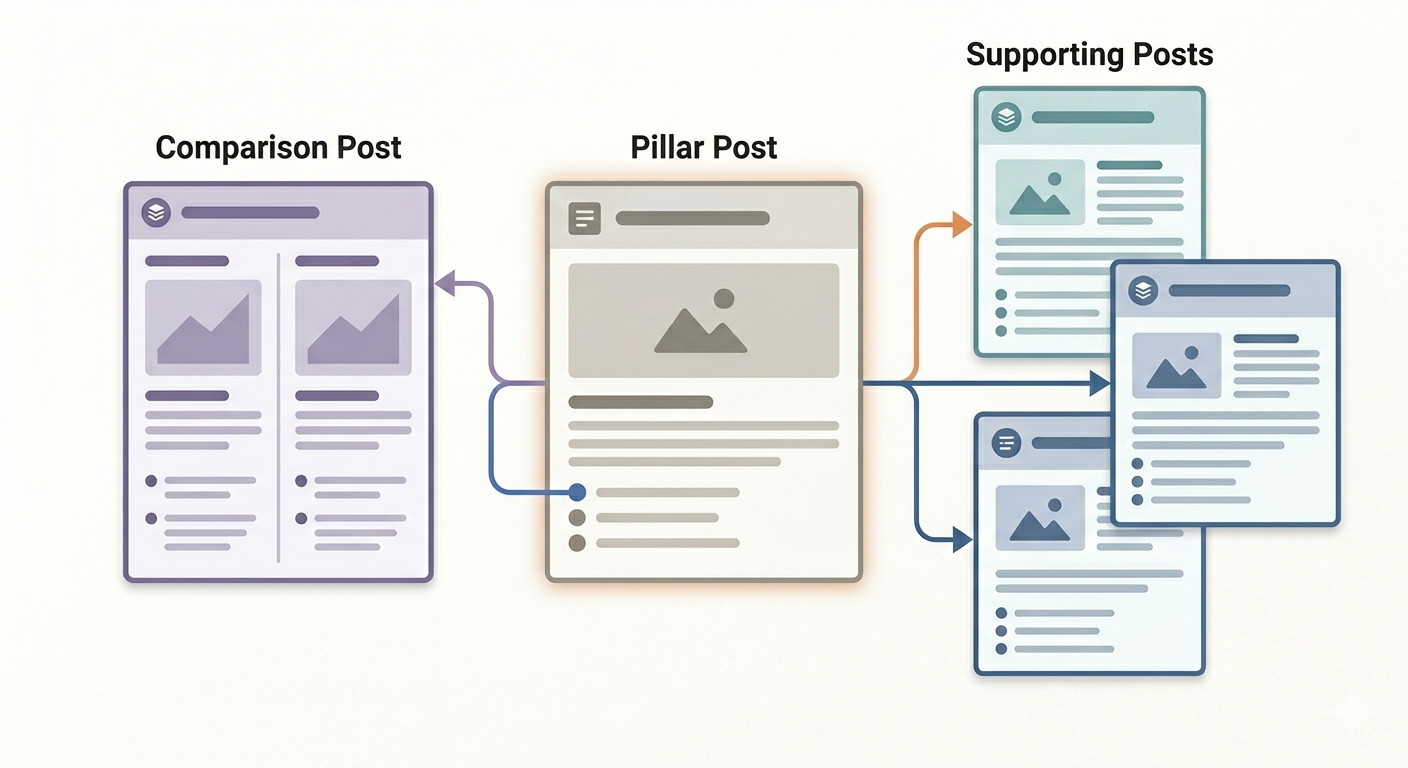
- Pillar post: explains the operating model
- Supporting post: explains one part in detail
- Comparison post: helps choose between two options inside the topic
The structure gets stronger when each post type stays in its own role.
For example, if the topic is technical blog operations, the pillar post can explain how structure, internal links, categories, and comparison posts work together. A supporting post can focus only on internal links. Another supporting post can focus only on category size. A comparison post can answer whether a problem should become a comparison post or a checklist post.
4. Do not let supporting posts pretend to be the center
A common failure pattern is letting a narrower post act like the main index because it gets more traffic or because it feels more concrete. That makes the cluster unstable.
Traffic can change. Structure should not. The center post should stay the center because it explains the map better, not because it is currently more popular.
If a narrower post starts attracting more visits, treat that as evidence that the topic matters, not as a reason to replace the pillar. The better move is usually to strengthen links between the narrow post and the real center.
5. Assign links by role, not by recency
Once the roles are clear, linking becomes easier. The pillar post links down to supporting posts. Supporting posts link back up to the pillar and sideways only when the next question is naturally adjacent.
That is better than linking based on recency or on whatever article was published last week.
A quick operating rule works well:
- pillar to supporting: always
- supporting to pillar: always
- supporting to supporting: only when the reader's next step is obvious
- comparison to pillar: always, so the decision stays inside the topic map
6. A small role map is enough
You do not need a large taxonomy. A small map is enough:
- one pillar post
- three supporting posts
- one comparison or decision post
If you cannot draw that map cleanly, the topic is still too vague or the post roles are not separated enough yet.
7. Use a quick role test before you publish
Before publishing, ask four short questions:
- Does this post define the topic, or solve one narrow question?
- If the post disappeared, would the topic map still exist?
- Can this post link back to a clearer center?
- Is this really a comparison post instead of a second pillar in disguise?
What to do first
Pick one topic cluster you already have and label each existing post as pillar, supporting, comparison, or stray. If two posts both claim to be the center, the structure is already drifting.